My views do not necessarily reflect the views of my employer.
December 29, 2025
Bora Bora is probably more famous than Mo’orea, but Mo’orea is where my mom stayed in one of those huts over the water.
I’d been to Mo’orea before, most memorably in 2023 on the Coral Princess. That time, I was able to get on a crew tour. We took a boat out and swam in the ridiculously clear water with manta rays and sharks before heading to a deeper bay for more swimming. I remember having a great time in someone else’s paradise.
We’d had a bit of drama (my exaggeration) before anchoring. I’d asked the Safety Officer where the tenders would be docking, and when he told me we’d be docking in a different bay than the one listed on the itinerary, I questioned what he’s said and he confirmed the location: the Tender Dock for Paul Gauguin in Opunohu Bay.
I’d already written everything else for my port talk, so at the last minute, I changed “Near the Pier” and “Getting Around” to be oriented from Opunohu Bay rather than Cook’s Bay.
Well, on Christmas morning (Merry Christmas), the Safety Officer called to tell me the pilot had given him different information- we’d be docking in Cook’s Bay after all.
So, in between all of our Christmas activities, I found the dock on the map, changed “Near the Pier” and “Getting Around” back to Cook’s Bay, and sent out messages to let the residents know about the change (most of them booked their own tours).
So please do not use the information below exclusively as your guide – I have no idea which version ended up on this page!
Since were docking in a different bay than we had when I visited on Princess, I figured I’d head ashore and explore.
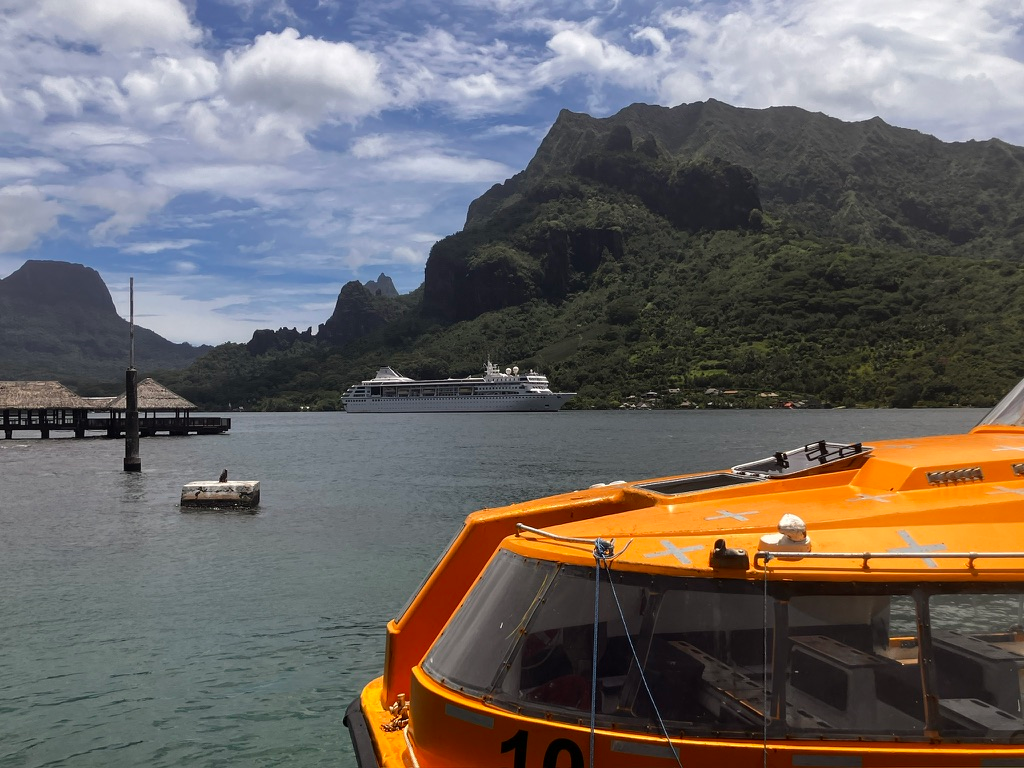
At the dock, I took a picture of the ship with the tender in the corner:
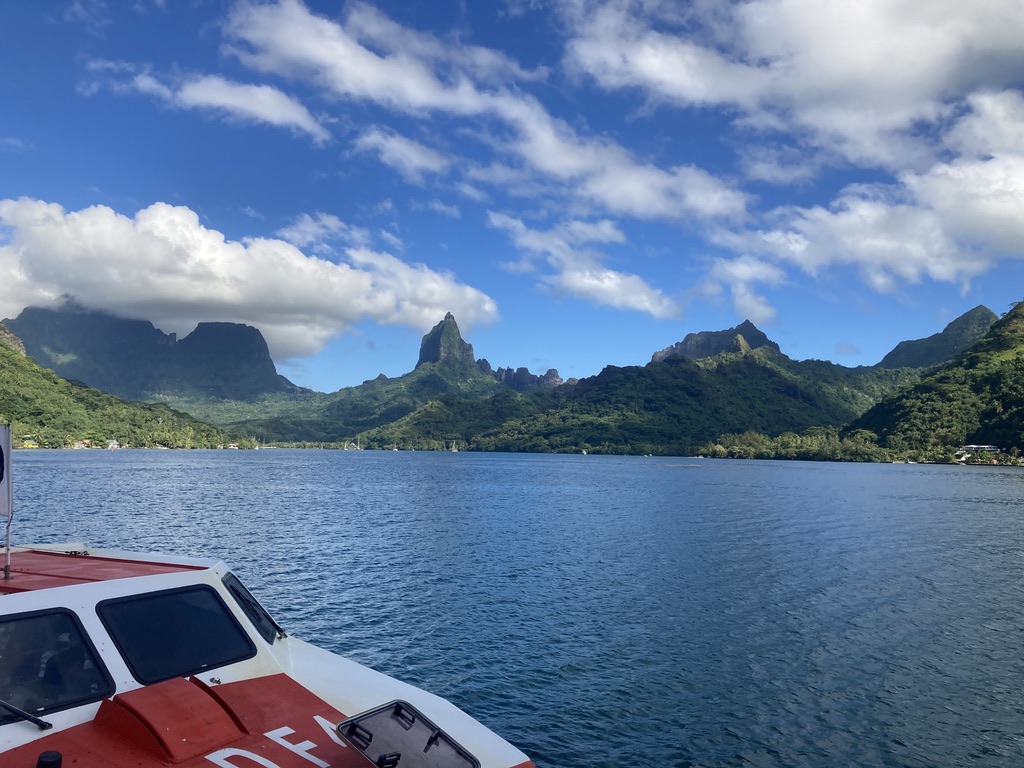
Reminicent of the picture I’d taken in 2023:
I walked out onto the road, ready to explore. It was still warm and humid but thankfully not as unbearably hot as it usually was outside. The road wasn’t particularly pedestrian-friendly or scenic so I pulled up Google Maps to see what was nearby.
The pizza restarant had already closed, but the restaurant at the hotel right by the tender pier was not only open, it had excellent reviews.
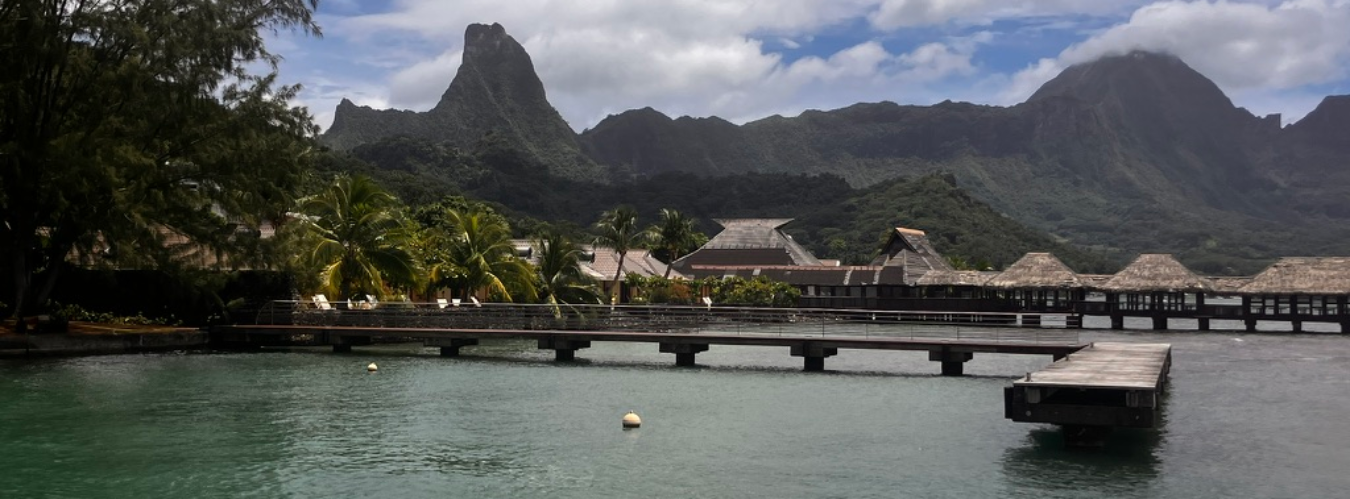
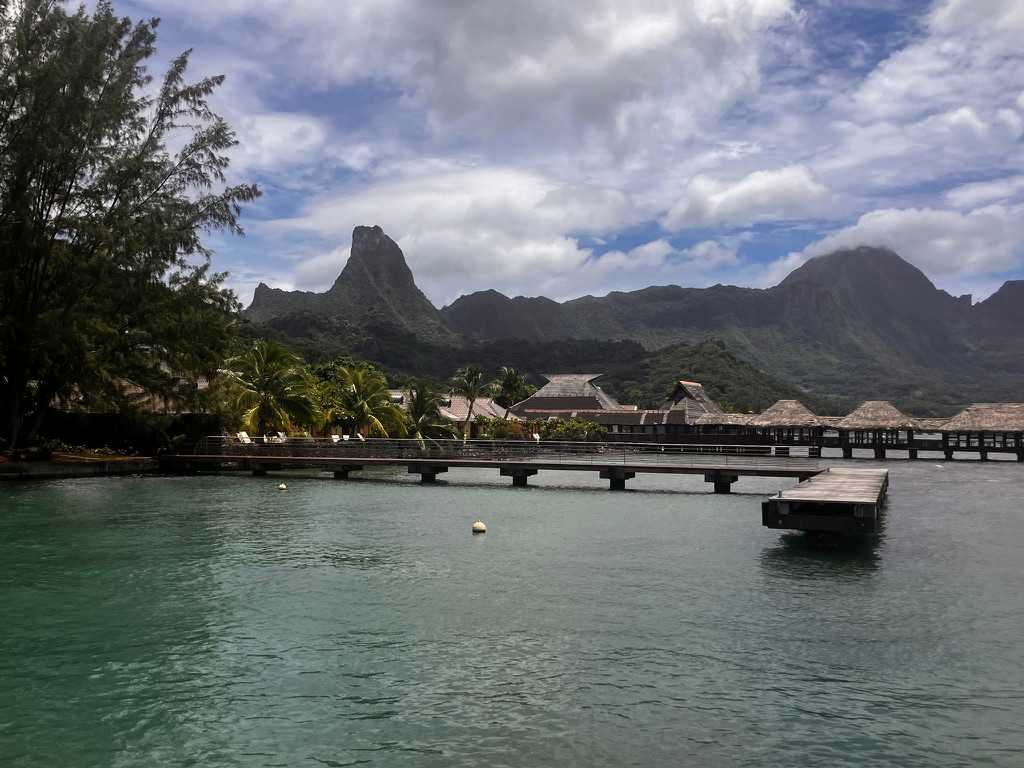
I settled into a table looking out over the water, sipping wine and nibbling on a cheese plate (because, after all, we were in France-ish).
And there I sat, enjoying my last afternoon on land before heading home.
Mo’orea, French Polynesia
Moorea sits just across the lagoon from Tahiti, a volcanic island of jagged green peaks, twin bays and a relaxed village rhythm. The commune of Moorea-Maiao has around 17,000 residents, with the largest settlement at Pao Pao at the head of Cook’s Bay. Its dramatic caldera, Opunohu Valley and reef-ringed lagoon feel like a natural amphitheatre. Think lush pineapple fields, waterfalls and marae inland, with clear shallows, rays and reef fish out front. Compared with busy Papeete, Moorea feels more small-town and outdoorsy: a place for lagoon days, lookouts, hikes, ATV rides and long, lazy lunches with mountain views.
History:
Moorea was settled by Polynesian voyagers many centuries before European contact, its valleys filled with stone platforms (marae), terraces and agricultural sites that once supported a much larger population. Oral traditions and archaeology link Moorea culturally and politically to neighbouring Tahiti, with chiefs and priests moving between islands and sharing religious and navigational knowledge.
European navigators began charting the island in the 18th century; Cook’s Bay takes its name from Captain James Cook, who anchored nearby in 1777. In the 19th century, Protestant missionaries arrived, building churches and encouraging village life along the coast. Over time, French influence grew, and Moorea became part of what is now French Polynesia, administered from Tahiti.
Through the 20th century the island remained relatively rural, with copra, pineapple and small-scale farming shaping daily life. Tourism expanded after regular ferry and air links were established; beach resorts ringed the north coast and Moorea’s lagoon became a playground for snorkelling, diving and whale-watching (in season). Today, Moorea balances agriculture (notably pineapple), local villages, and a mature tourism scene. Visitors find an easy mix of French-Polynesian culture, outdoor activities, and quiet evenings under a very starry sky.
Itinerary:
Arrival: Saturday December 27, 7:00am (please allow time for port clearance)
Departure: Monday December 29, Last Tender: 6:00pm Sail away: 7:00pm
Mo’orea Tender Schedule:
| First Tender | Last Tender | ||
| 27-Dec-25 | Sat | 8:00 AM | 9:00 PM |
| 28-Dec-25 | Sun | 8:00 AM | 9:00 PM |
| 29-Dec-25 | Mon | 8:00 AM | 6:00 PM |
Please note: After 6:00 PM the service will operate at one-hour intervals until the final tender at 9:00 PM.
Approximate time from ship to shore: 15-20 minutes
Weather
Average Temps: High / Low: Around 30–31°C / 24°C (86–88°F / 75°F)
Climate: This is rainy season. December is typically Moorea’s wettest month, with heavy but often short tropical downpours and plenty of sunshine between showers.
What to Wear: Light, breathable clothing; quick-dry fabrics are your friend. Reef-safe sunscreen, wide-brimmed hat, good sunglasses. Sturdy sandals or water shoes for boat ladders, coral and wet docks. For hikes/ATV: closed-toe shoes with grip; expect mud and slick roots. A compact umbrella or light rain jacket for sudden showers.
Tender Dock: Cook’s Bay
Google Maps: Tender Dock for Paul Gauguin
Nearby Essentials
Pharmacy: Pharmacie de Cook’s Bay (Pharmacie Paopao) – approx. 5–10 minute walk or short taxi ride
ATM: Banque de Polynésie (BP) ATM or Socredo ATM in Paopao – approx. 5–10 minute walk
Grocery / Snacks: Champion Supermarket (Cook’s Bay / Paopao) – approx. 5–10 minute walk; good for drinks, snacks, and basics
Nearest Church: St. Joseph’s Catholic Church – approx. 5–10 min by taxi or bike
Nearest Golf: Moorea Green Pearl Golf Course – approx. 15 min by taxi (Temae side of the island)
Nearest Shopping (mall/market): Small local shops and souvenir stalls around Cook’s Bay; larger selection at Champion Supermarket and shops in Paopao village
Getting Around:
🚶 Walking: The immediate bay area is pleasant for short walks along the waterfront and to nearby viewpoints, churches, and small shops. Roads are narrow with minimal shoulder in places; fine for a gentle stroll but not ideal for long-distance walking between bay and villages like Maharepa.
🚌 Public Transit: Important: There is effectively no regular public bus service on Moorea anymore (except school buses). Older online timetables are out of date. Do not plan your day around a public bus; use pre-booked tours, shuttles, or rentals instead.
🚖 Taxis: Taxis are limited and can be expensive: even short rides routinely run XPF 2,500–4,000 (about US$20–35). There are also shared shuttle services and transfer companies that can be pre-arranged; they often meet ferries and cruise tenders. Tip: For anything more than a quick hop, it’s often cheaper and easier to hire a driver for several hours or join a small-group island tour.
🚗 Car Rentals: Car rental offices cluster near the ferry terminal (Vaiare) and some key resort areas; a loop of the island is about 60 km (38 mi). Scooters are popular and available through local outfits and app-based schemes in some areas; they’re great for experienced riders but not ideal for first-timers.
Hop-On Hop-Off? No true hop-on hop-off bus.
Witnessing:
Belvedere Lookout High above Opunohu Valley, Belvedere Lookout frames both Opunohu and Cook’s Bay, ringed by spiky green peaks, and is one of the most famous viewpoints in the Pacific (you may recognise it from films and countless postcards).
- Practical: Reachable by car, scooter or 4×4 from the bay; many tours include it. Short, uneven paths at the top.
- Visit Time: 20–40 minutes at the viewpoint, plus travel.
Tip ✨ Go earlier in the day for clearer views; cloud often builds over the peaks by afternoon.
Opunohu Valley & Ancient Marae The lush Opunohu Valley is scattered with historic marae (stone temple platforms), old agricultural terraces and colour-coded trails that range from easy walks to more challenging hikes.
- Practical: Access by road from the bays; best visited with a guide, ATV/4×4 tour, or as part of a hiking excursion.
- Visit Time: 2–4 hours depending on how much walking you do.
Tip ✨ This is where Moorea’s history and scenery overlap beautifully—remind guests to wear shoes they’re happy to get muddy.
Lagoon & Motu Snorkelling Moorea’s lagoon is famous for shallow turquoise water, coral gardens, rays, and reef fish. Lagoon tours often visit sandbanks where you can stand waist-deep with rays gliding by, then move to deeper snorkel spots with coral heads and schools of fish.
- Practical: Reached by boat from various piers; snorkel gear usually included.
- Visit Time: Half-day or full-day tours.
Tip ✨ Emphasise reef-safe sunscreen and rash guards—not only for guests’ skin but also to protect fragile coral.
Moorea Green Pearl Golf Course Near Temae on the east coast, Moorea Green Pearl is an 18-hole, par-70 Jack Nicklaus-designed course threading between lagoon and volcanic slopes, with several holes climbing into the old crater for dramatic ocean views.
- Practical: 30–40 minutes from the bays by taxi or rental car; pre-book tee times and rentals.
- Visit Time: 3.5–5 hours for a relaxed round.
Tip ✨ Great for keen golfers in your resident base—remind them to factor in travel time and tropical heat when booking tee times.
Learning:
Opunohu Agricultural School Located along the scenic road to Belvedere Lookout, Moorea’s agricultural high school is a fascinating stop. Students from across French Polynesia study here, managing hundreds of acres of pineapple fields, vanilla vines, coffee plants, fruit trees, ornamental flowers, and traditional Polynesian crops. Visitors can browse a small shop selling locally made jams, juices, vanilla, liqueurs, and other products—often at excellent prices.
- Practical: On the Opunohu Valley road en route to Belvedere; easy to combine with a lookout visit.
✨ Tip: Their fresh pineapple juice and homemade jams make great souvenirs and support local students.
St. Joseph’s Catholic Church A charming, brightly painted seaside church located near Cook’s Bay, St. Joseph’s is one of Moorea’s most photographed landmarks. Known for its red roof, white façade, and simple island architecture, it offers a peaceful place to step inside for reflection or admire Polynesian Catholic artwork.
- Practical: Located along the coastal road near Cook’s Bay; easily visited during an island drive or bike ride. Usually open during daylight hours but not staffed continuously.
✨ Tip: Sunrise light across the bay makes for beautiful photos of the church exterior.
Juice Factory / Distillery Tours (Rotui Area) Near Cook’s Bay, the Moorea juice factory area offers a look at how local fruit juices—and some liqueurs—are produced. Visitors can explore a small tasting room, sample a variety of juices and spirits, and browse a shop selling bottled juices, fruit wines, and island-made liqueurs.
- Practical: Located in the Rotui complex near Cook’s Bay; easy to visit by taxi, bike, or as part of a Moorea island tour.
✨ Tip: Tastings are usually free, and the passionfruit juice is a resident favorite.
Discovery:
Beach Time at Temae or Hauru Point – Public beaches like Temae (near the ferry/airport side) or beaches near Hauru Point on the northwest coast offer classic white sand, shallow lagoon and good snorkelling from shore.
ATV / 4×4 Adventure – Popular small-group tours take guests along back roads, through pineapple fields and up to vistas like Belvedere; bumpy but fun and not too technical.
Kayaking & Stand-Up Paddleboarding – Calm sections of Opunohu and Cook’s Bay are ideal for paddling; many operators and hotels rent kayaks and SUPs.
Hiking (All hikes require good footwear, water, and awareness of heat and trail conditions.)
Belvedere Trails & Valley Loops – From the Belvedere area, colour-coded trails explore the valley floor, forest and archaeological sites.
- Access: Start from Belvedere car park; some sections signposted.
- Difficulty: Easy–moderate, depending on route; can be shortened.
Three Coconuts Pass (Col des 3 Cocotiers) – Classic Moorea hike from Opunohu Valley up to a saddle with sweeping views of the caldera and bays.
- Access: Trailheads in Opunohu; often done as a guided hike.
- Difficulty: Moderate–strenuous; long, steady uphill, often muddy.
Magic Mountain – A shorter, steeper climb (or 4×4 track) to a lookout over the lagoon and motu in the northwest.
- Access: Usually visited on ATV/4×4 excursions.
- Difficulty: Moderate; steep but relatively short.
Biking
Cook’s Bay Loop Spin – Gentle ride following the shoreline around Cook’s Bay with constant views of cliffs and water.
- Access: Start from tender area if you’re in Cook’s Bay, or ride in from elsewhere.
- Difficulty: Easy–moderate; rolling terrain, occasional traffic.
Opunohu Bay Circuit – Similar ring around Opunohu Bay; very scenic, with access to valley roads, beach pull-outs and snorkel spots.
- Access: From Papetoai/tender area.
- Difficulty: Easy–moderate; watch for curves and limited shoulder.
Bay-to-Bay Coastal Ride – Longer route linking Cook’s and Opunohu Bays via the coastal road.
- Difficulty: Moderate; best for confident cyclists comfortable with mixed traffic and heat.
Cyclists Onboard Note – Moorea is widely considered excellent for exploring by bike/scooter, but: no bike lanes, variable shoulders, tropical downpours, occasional dogs, and strong sun. Strongly recommend morning rides, helmets, lights, and reflective gear; avoid riding in darkness or heavy rain.
Shopping
- Cook’s Bay / Pao Pao Area: A larger local supermarket at the bottom of the bay (often called Supermarché Are or similar) for snacks, drinks, and basic supplies.
- Maharepa Village: Cluster of shops, cafés, banks/ATMs, bakery and small boutiques selling clothing, pareos, jewellery and souvenirs; everything within walking distance once you’re there.
Tasting:
- Fresh Lagoon Fish & Seafood – Grilled mahi-mahi, tuna and reef fish with vanilla or coconut sauces.
- Roadside Fruit & Snack Stands: Seasonal stalls selling pineapples, mangoes, bananas, and fresh juice – a simple but memorable stop.
- Pineapple Everything: Moorea is famous for sweet pineapples – fresh slices, juices, jams and desserts.
- Rotui Juices & Local Rum-Based Drinks: Taste local fruit juices and mixed drinks made from them; some products include rum liqueurs (age-restricted, of course).
Irish pubs & Mexican: Moorea doesn’t really have “pub row” or dedicated Irish/Mexican venues like a city; guests looking for that vibe are better off in Papeete.
Nightlife:
Moorea is quiet at night. Expect: Bars and lounges at resorts with sunset cocktails and occasional live music. A few local bars/snacks that stay open late in village areas.
*This information is provided for the convenience of our residents and guests. While every effort has been made to ensure accuracy at the time of preparation—including tour details, operating hours, transportation options, pricing, and local regulations—conditions in port may change without notice. Weather, sea state, cultural events, business availability, and safety considerations can affect access to local attractions or services.
Residents are encouraged to use their own judgment, follow local guidance, and confirm details independently when planning activities ashore. Villa Vie Odyssey, its crew, and its representatives are not responsible for changes, closures, or incidents that may occur while guests are ashore.
For your safety, always return to the ship by the designated all-aboard time, and follow instructions from local authorities and shipboard staff at all times.